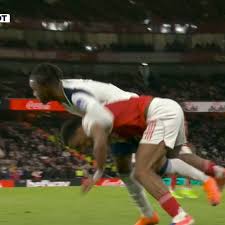
Destiny Udogie Reveals what Referee Mike Oliver told him that got him angry with Timber
The North London derby rarely disappoints for drama, but amid Arsenal’s commanding 4–1 victory over Tottenham, one moment stole the spotlight: the heated confrontation between Destiny Udogie and Jurriën Timber. What seemed like a routine stoppage escalated into a tense face-to-face exchange, prompting intervention from both sets of players — and renewed discussion about the referee’s handling of the match.
Now, Udogie has shed light on the spark that ignited the situation, revealing an unexpected remark from referee Michael Oliver in the seconds before tempers flared.
Arsenal’s intensity was evident from the opening whistle. The Gunners pressed aggressively, challenged fiercely, and capitalised clinically, with Eberechi Eze’s hat-trick powering them to a memorable derby win. Every duel felt charged, and no area of the pitch simmered hotter than Udogie’s flank, where Timber pushed up aggressively and often clashed with the Spurs full-back.
Midway through the first half, after a collision that left Timber briefly down, Oliver paused play. What followed was the derby’s most contentious moment — Timber stepped toward Udogie, words were exchanged, and both players squared up before teammates rushed in to separate them.
At the time, the cause of Udogie’s sudden anger wasn’t clear. Now, according to the defender, the trigger came from the man in the middle.
Udogie: “That comment didn’t sit right with me.”
Speaking after the match, Udogie admitted that he was already frustrated by Arsenal’s aggressive approach, but it was Oliver’s tone that tipped him over the edge.
“He looked at me and said, ‘Calm down, kid — I’ll sort him later.’
I felt like I was being dismissed. I’m not a kid out there. I’m competing, I’m fighting for the badge. That comment didn’t sit right with me, and in a derby like this, emotions are already high.”
Witnesses saw Udogie’s expression change instantly after Oliver spoke to him. Moments later, Timber approached, the two exchanged words of their own, and the confrontation erupted.
A Referee’s Fine Line
Referees walk a tightrope in derby matches — controlling the energy without extinguishing the competitive fire that defines these fixtures. Oliver, known for his calm demeanour, has overseen countless high-intensity Premier League clashes. Yet his approach in this situation will undoubtedly spark debate among fans and pundits.
Some supporters felt Udogie was harshly spoken to. Others argued the referee was simply trying to prevent an escalation. But what’s clear is that the phrasing — particularly the word “kid” — struck a nerve with a player who prides himself on maturity, strength, and leadership.
Timber’s Role and the Aftermath
As for Timber, the Arsenal defender stayed unapologetically combative throughout the match, pressing high and stepping into duels with conviction. His challenge moments earlier was part of Arsenal’s aggressive tactical blueprint — one Tottenham struggled to counter.
After the clash was defused, both players received stern warnings, but no cards were shown. The match moved on. Tottenham, however, never truly recovered their composure, and Arsenal’s dominance grew.
A Flashpoint That Will Be Remembered
Derbies are defined not just by goals but by moments — the confrontations, the rivalries, the emotional turning points. Udogie’s revelation adds a new layer to the story of this North London derby, offering insight into the human dynamics at play beyond the tactical and technical battles.
Tottenham will regret their performance. Arsenal will relish their statement win. But when fans look back on this fixture, the clash between Udogie, Timber, and the referee will be discussed just as much as the goals.
And according to Udogie, one unexpected sentence from Michael Oliver was all it took to light the fuse.


Post Comment