Breaking: Ange Postecoglou Responds to Van de Ven’s Controversial Tactical Claims With Fiery Words
Ange Postecoglou Responds to Van de Ven’s Controversial Tactical Claims With Fiery Words
In a revealing insight into his Europa League triumph, Ange Postecoglou explained the thinking behind Tottenham’s tactical approach in Europe, showing how he adapted without abandoning his core footballing philosophy. The Spurs manager reflected on the pedigree of recent Europa League winners and what lessons he drew from them.
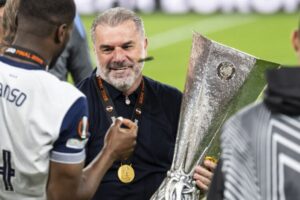
“I did a deep dive into who’s been successful in this competition over recent years,” Postecoglou explained. “You’ve got Unai Emery, who’s won it three times, José Mourinho, Oliver Glasner, and I think even Diego Simeone has lifted it. When you look at it, there’s a clear thread in the kind of football these managers played. It’s a very different competition from the Champions League. In the Champions League, the disparity between the top teams and the weaker teams is massive—you nearly always see the elite sides coming out on top.
“But in the Europa League, the difference isn’t as pronounced. When you compare, say, a Premier League team to a side finishing fourth or fifth in Germany or Spain, it’s much more competitive. That’s why I wanted to observe what worked and adapt it for the squad I had.”
Postecoglou went on to describe the tactical model he implemented. “What I noticed successful teams doing in this competition was keeping things risk-free, with strong defensive organisation. That became our blueprint. I knew that if we could somehow create that model with the players I had, we’d have a chance. Key to that were players like Van de Ven and Cristian Romero, who could anchor the defence. I even spoke to the squad about it—half in jest, half seriously—but I wanted them to buy in. It was a slight departure from our usual style, but they were all in. I told them, ‘This is how we’re going to navigate this tournament. Cup football is different from league football, so we need to prepare differently.’ And that’s exactly what we did—we trained differently, we prepared differently, and it paid off.”
Staying True to Style in the Premier League
While Spurs adopted a more pragmatic approach in Europe, Postecoglou made it clear that he did not intend to replicate this style in the Premier League, despite domestic struggles. “People will say, ‘Why don’t you play like that in the league?’ Well, the club tried that under Antonio Conte for two years, and it wasn’t popular. That’s not what the club wanted. They brought me in to play attacking football, so that’s what we did domestically. The Europa League was a specific process with a clear goal—we could implement a strategy designed to win a competition, and that’s what we focused on.”
The Spurs boss described the decisive moments in the final: “By the end of the final, I had put Kevin Danso on to shift the back four into a back five, and brought on Djed Spence as well. I think we had seven defenders on the pitch at one point. I was even glancing at the bench to see if there were any other defenders left! I could hear my dad in my head saying, ‘What are you doing?’ But I knew if we shut down Bruno Fernandes, Manchester United wouldn’t score.
“With the way they set up under Rúben Amorim—the patterns they’d use to try to break us down—being defensively solid was key. Of course, we still pressed aggressively, we still attacked when we could, but the focus was on defensive rigidity. A more direct approach was necessary, but only because this was a unique opportunity—a chance to win a major trophy.”
The Balance Between Pragmatism and Philosophy
Postecoglou’s comments underline the fine line managers walk between sticking to their principles and adapting for success in knockout competitions. While Spurs maintained their attacking identity in the Premier League, their Europa League campaign showed the importance of tactical flexibility. By blending solid defensive organisation with selective attacking moments, Postecoglou guided Tottenham to a historic European triumph, proving that success in cup competitions often demands a tailored, intelligent approach.









Post Comment