Spurs request stern investigation into major refereeing errors made by John Brooks after undeserving loss
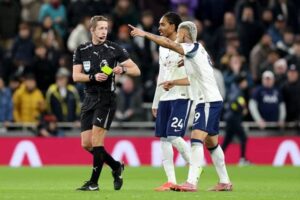
After a controversial evening loss in north London, Tottenham Hotspur have formally called for an investigation into the officiating of their Premier League clash with Liverpool, a match that ended in a dramatic and deeply controversial 2–1 defeat for the hosts. The club’s decision follows widespread anger over two red cards shown to Spurs players and a highly disputed winning goal for the visitors — moments many believe fundamentally altered the outcome of the contest.
What was expected to be a fiercely competitive fixture instead descended into disorder, with referee John Brooks at the centre of the storm. From the stands to the dressing room, the prevailing sentiment was one of disbelief that such pivotal decisions could go against Tottenham in a single match.
What went wrong — the pivotal moments
The first red — a VAR-upgraded dismissal
The flashpoint arrived just 30 minutes into the game. Tottenham midfielder Xavi Simons was initially shown a yellow card for a late challenge on Liverpool captain Virgil van Dijk. However, following a VAR review, Brooks was summoned to the pitch-side monitor and upgraded the caution to a straight red for what was deemed “serious foul play.”
The decision immediately changed the complexion of the match, forcing Spurs to play more than an hour with ten men. While few disputed that the tackle was mistimed, both the club and its supporters felt it fell short of the threshold required for a sending-off. Manager Thomas Frank later described the call as “too harsh,” arguing that the balance of the contest was irreversibly skewed from that moment onward.
The second goal — a controversial aerial challenge
Despite the numerical disadvantage, Tottenham showed resilience and began to regain composure late in the second half. That momentum, however, was abruptly halted when Liverpool striker Hugo Ekitike headed home what proved to be the winning goal.
According to Frank, the goal should never have stood. He claimed Ekitike used “two hands into Cristian Romero’s back” to gain elevation — an infringement that should have resulted in a foul. Romero and several Spurs players protested furiously, but VAR ruled the contact to be “normal” for an aerial duel, allowing the goal to stand.
For Tottenham, this moment represented a second decisive error — and arguably the most damaging. At a point when the game was still salvageable, the ruling extinguished their hopes and intensified the sense of injustice coursing through the stadium.
The final blow — another red card under pressure
The drama was not yet over. Deep into stoppage time, with Spurs pushing desperately for an equaliser, Romero received a second yellow card following an altercation with Liverpool defender Ibrahima Konaté. Frustration had clearly boiled over, but many felt the booking lacked context given the earlier incidents.
Reduced to nine men, Tottenham’s final chance evaporated. What remained was a team stretched to its limits and a crowd seething at what they perceived to be relentless punishment from the officiating team.
The aftermath — fury, disappointment, and demands for accountability
Inside the dressing room, emotions ran high. Frank did not hold back in his assessment of the referee’s performance.
“There is a massive mistake by John on the pitch,” he said. “Two hands on the back by Ekitike. I don’t understand how he didn’t see it. That was the second mistake.”
He went further, suggesting that had the crucial decisions been handled correctly, Romero might never have been booked in the first place — meaning the second yellow, and subsequent red card, could have been avoided entirely.
The reaction in the stands mirrored that anger. Fans, initially stunned by Simons’ dismissal, grew increasingly vocal as the match wore on. At full-time, boos rang out around Tottenham Hotspur Stadium — not aimed at the players, but squarely at the officials.
John Brooks’ performance has only intensified existing scrutiny. Already criticised in the past for VAR-related controversies, the referee now finds himself under renewed pressure as dissatisfaction grows among one of the league’s most prominent clubs. In response, Spurs confirmed their intention to formally request an investigation, arguing that the officiating decisions materially changed the match and denied them a fair opportunity to compete.
Why this matters — more than just one loss
This controversy extends beyond a single defeat. For Tottenham, the consequences are significant:
A worrying run of home form continues, further denting confidence and league position.
The club’s disciplinary issues are exacerbated, with two red cards in one match leading to suspensions and reduced squad depth in the weeks ahead.
Perhaps most damaging is the psychological impact. Losing at home is painful enough, but losing amid such perceived injustice risks leaving a lasting scar on both players and supporters.
For the Premier League and its officiating bodies, the match raises uncomfortable questions about consistency, accountability, and trust in VAR. When two major decisions in one game provoke such intense backlash, it inevitably invites scrutiny over how many other matches may have been similarly affected — albeit without the same spotlight.
What’s next — can this lead to real change?
Tottenham’s hierarchy has made it clear they want answers. A formal review could involve a detailed post-match report examining both red cards and the decision to allow Liverpool’s second goal. There may also be a broader evaluation of the VAR process, particularly its role in overturning on-field decisions.
Potential outcomes could range from internal criticism and retraining to temporary suspensions for officials, depending on the findings. A reversal of the result remains highly unlikely, but acknowledgement of errors could help restore some measure of faith in the system.
For Spurs, the challenge now is to channel frustration into resolve. Even down to nine men, the players fought until the final whistle — a level of commitment that will be vital if they are to climb out of their current slump.
Final word
In football, refereeing decisions can define matches — but rarely do they ignite this level of collective outrage. For Tottenham, the controversy surrounding John Brooks is not merely a talking point; it represents a profound sense of injustice in a match they desperately needed to salvage.
Whether the club’s demand for an investigation will result in meaningful change remains to be seen. What is certain is that the anger of the supporters, the frustration of the players, and the feeling of having been wronged will not fade quickly.
For now, Spurs are demanding accountability. And if the league and its officiating authorities hope to rebuild trust, they must be prepared to confront the storm head-on.








Post Comment