Cuti Romero reveals the brief words John Brooks told him that triggered his angry reaction
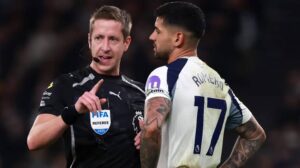
In the wake of Tottenham Hotspur’s turbulent 2-1 home defeat to Liverpool, a detailed and explosive account has emerged that has pushed the controversy far beyond the pitch. Club captain Cristian Romero has reportedly revealed what referee John Brooks allegedly said to him during the match — comments that have now fuelled internal discussions at Spurs over the possibility of legal action.
What unfolded in front of more than 61,000 supporters at the Tottenham Hotspur Stadium has since been described by club sources as one of the most damaging officiating performances in recent memory. Here is a breakdown of how a fiercely contested fixture spiralled into chaos — and why Tottenham’s anger continues to grow.
From Level Contest to Total Collapse
The match began as a tense but evenly matched affair, with both sides probing cautiously. However, the balance was shattered in the 33rd minute. Xavi Simons was initially shown a yellow card for a challenge on Virgil van Dijk, but after a VAR review, referee John Brooks upgraded the booking to a straight red for what was deemed “serious foul play.”
The decision instantly reduced Tottenham to ten men and set the tone for a fractious afternoon. Despite the numerical disadvantage, Spurs showed resilience and managed to stay compact for the remainder of the half.
That resistance began to crumble shortly after the restart. In the 56th minute, Liverpool exploited the extra space, with substitute Alexander Isak finishing a swift attacking move to give the visitors the lead.
Worse followed roughly ten minutes later. Hugo Ekitike rose above Romero to power home Liverpool’s second goal, which was upheld after a VAR check. Tottenham’s players and coaching staff were incensed, insisting the French forward had clearly used both hands to push Romero in the build-up — an offence they believed should have ruled the goal out.
Despite the mounting adversity, Spurs refused to fold. Even after Romero was dismissed in stoppage time for a second yellow card — awarded for a late kick at Ibrahima Konaté — the hosts nearly pulled off an extraordinary comeback. Richarlison’s 83rd-minute strike reignited hope, and the closing stages saw Tottenham throw everything forward in a desperate, ultimately unsuccessful, search for an equaliser.
Aftermath: Anger, Accusations, and Legal Considerations
The fury did not subside at the final whistle. Tottenham head coach Thomas Frank launched a scathing post-match assessment, singling out the decision to allow Ekitike’s goal as a critical error. He questioned both the referee and the VAR officials for what he described as a clear failure to identify a blatant foul on Romero.
Frank was uncompromising in his assessment.
“There is a massive mistake by John on the pitch,” he said. “Two hands on the back by Ekitike — I don’t understand how he didn’t see it. OK, we have VAR, but they didn’t help when it mattered.”
The Spurs boss also argued that had the foul been given, Romero would never have been placed in a position to receive a second yellow card, potentially altering the closing stages of the match.
In the days following the defeat, sources close to the club revealed that Romero has shared what Brooks allegedly said to him during the heated exchanges on the pitch. Those comments reportedly angered the Argentine defender to such an extent that Tottenham have begun internal discussions about whether the referee’s conduct breached professional standards.
While no formal complaint or legal filing has yet been made, the mere consideration of legal action represents a rare and significant escalation in disputes over officiating.
Why Spurs May Seek More Than an Apology
From Tottenham’s perspective, this controversy extends far beyond one contentious decision. The club believes the match exposed deeper structural issues within officiating and VAR implementation.
They point to the red card shown to Simons after VAR intervention — a decision many observers felt was harsh rather than reckless — and to Liverpool’s second goal, which appeared to involve illegal physical contact that went unpunished.
The consequences have been far-reaching. Simons now faces a multi-match suspension, Romero will miss upcoming fixtures, and the psychological impact on the squad has been considerable. Spurs argue that these outcomes stem from errors that were avoidable and compounded over the course of the match.
Should the club pursue the matter formally, any action would likely focus on accountability rather than overturning the result. In extreme circumstances, financial compensation or formal acknowledgements of error could be sought if it is proven that officiating protocols or codes of conduct were breached.
What Comes Next
If Tottenham decide to escalate their response, several potential outcomes are on the table:
A comprehensive post-match review by refereeing authorities, with the possibility of internal investigations.
Disciplinary or professional repercussions for officials involved, should misconduct or serious error be established.
Increased public scrutiny of Premier League officiating standards, further damaging trust in VAR and match officials.
A strong signal from Spurs that controversial decisions will no longer be met with silence.
The Wider Implications
Beyond Tottenham, this episode highlights a growing crisis of confidence in football officiating. That a club is even contemplating legal avenues over a refereeing performance illustrates just how strained trust has become.
VAR was designed to reduce controversy and promote fairness. When it fails in high-profile matches — and when multiple reviews still allow disputed decisions to stand — the fallout extends well beyond a single fixture.
For Tottenham supporters, the pain of defeat is compounded by a deep sense of injustice. For neutrals, the match serves as a warning about the fragile credibility of officiating systems in elite football.
Final Word
Cristian Romero’s alleged account of his exchange with John Brooks — and Tottenham’s readiness to explore unprecedented avenues of response — could define one of the most contentious moments of the 2025–26 Premier League season.
More than just a disputed result, this incident may mark a turning point in how clubs challenge officiating decisions: with sustained pressure, formal complaints, and potentially legal action.
Whether meaningful accountability follows remains uncertain. What is clear, however, is that for Tottenham Hotspur, the anger, the sense of injustice, and the demand for answers are not going away anytime soon.







Post Comment